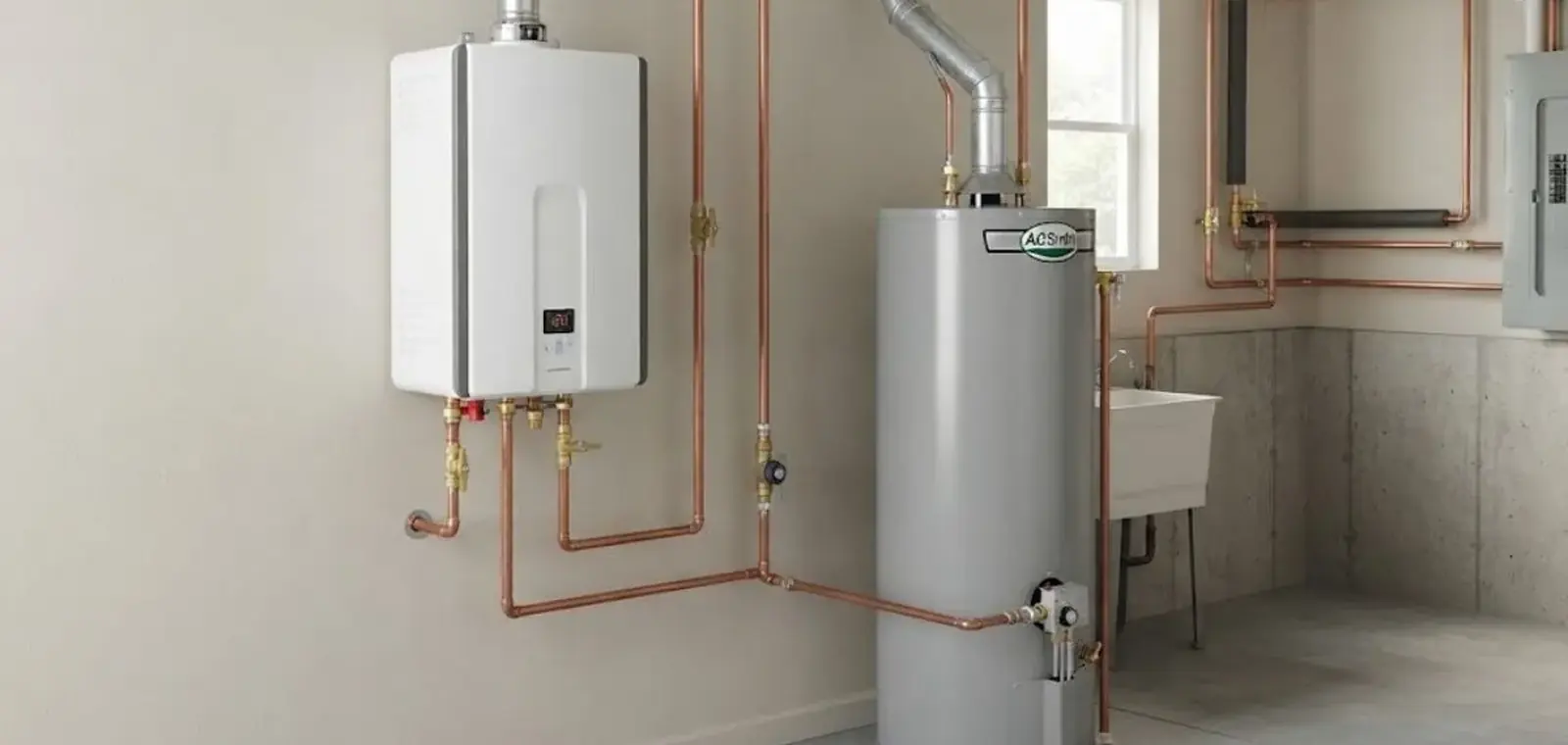
A tankless water heater heats water as it flows instead of storing it. That saves floor space and removes the risk of a tank failing and flooding the room. It also asks more of the installer, since gas lines, venting and water quality all have to suit the unit. Call the same line we use for emergencies to schedule an install, a repair or a flush.
Is tankless right for your home
Tankless suits households that run out of hot water, homes with limited space and people who want lower standby loss. It is a poor match when the gas line is undersized and cannot be upgraded, or when you rarely use hot water.
| Feature | Tankless | Tank |
|---|---|---|
| Hot water supply | Continuous, limited by flow rate | Limited by tank size |
| Space | Wall-mounted, small | Floor space needed |
| Upfront cost | Higher | Lower |
| Maintenance | Annual descale flush recommended | Annual drain and anode check |
| Installation needs | Gas line sizing and special venting, or large electric service | Standard connections |
Installation details that matter
- Gas line capacity: a tankless unit can demand far more than a tank
- Venting material and routing, which differ by model
- Condensate drain for high-efficiency units
- A shutoff and flush ports for servicing
- Electrical power for the controls and fan
- Pressure and flow checks at your fixtures
Descaling and flushing: the maintenance tankless needs
Columbus reports that it softens water to an average of 120 parts per million, roughly 7 grains per gallon. In moderately hard water, scale forms on the heat exchanger of a tankless heater. It narrows the passages, reduces output and can trigger error codes. A yearly flush with a descaling solution, using the service valves on the unit, prevents most of it.
If your tankless heater has stopped giving steady hot water, shows an error code or has been installed for several years without a flush, a descale visit often restores it. We also check the inlet screen and the venting.
Repairs and error codes
Common faults include a blocked inlet filter, a failed flow sensor, an igniter that does not light and a condensate line that has clogged. Each has a distinct code. We read the code, test the part and explain what we find before replacing anything. If the unit is too old or the heat exchanger is cracked, we say so.
Pairing tankless with a softener
A water softener reduces scale and can help a tankless heater. It is not a substitute for a flush. Read water softener and filtration if you are weighing the two.
What drives the price
- The unit and its capacity
- The gas line, vent and electrical work needed
- Whether you are replacing a tank and need new connections
- Permit and disposal of the old heater
- For service: scale level and the number of years since the last flush
You get a clear price before work starts. The city states plumbing work needs a permit, and contractors must be registered with the Building Department, so we confirm how it applies.
Call to schedule. A dispatcher will ask about the unit and book the earliest appointment that fits.
If you are comparing options, water heater installation covers tank types, and water heater repair covers failures in either type.
Questions we hear from callers
Once a year is a good interval in moderately hard water. Homes with a softener may stretch it, and the manufacturer's guidance sets the minimum.
Codes point to a fault: no ignition, a vent blockage, a flow problem or scale. We read the code and test before replacing parts.
Usually, if the gas line, vent and space allow it. We check on site and quote any upgrades.
Most need electricity for the controls and fan, so they stop when the power fails. A battery backup or generator can keep one running.
Often much longer than a tank, with proper flushing. Scale buildup is what shortens it.
Yes. The line is answered 24/7. Tell the dispatcher if the unit is leaking or if there is a gas smell, in which case leave the house and call the gas utility first.