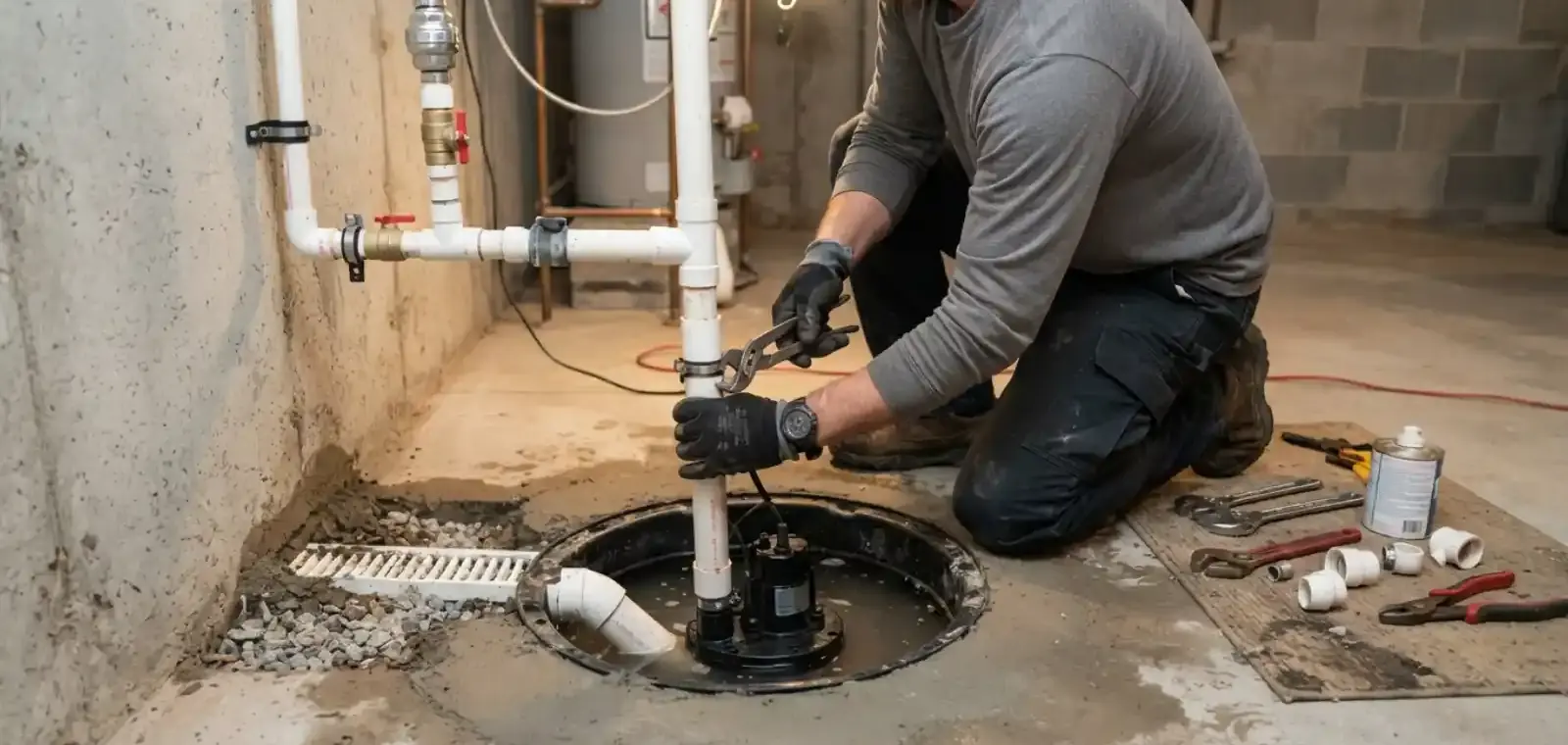
If your basement is taking on water and the sump pump is not running, check that it is plugged in, that the float moves freely and that the discharge line is not frozen or blocked. If you cannot restart it quickly, call our 24/7 line. Keep out of standing water near outlets and the panel, and move stored items to shelves. A dispatcher will tell you what else to do.
Emergency basement water: what a failing pump looks like
- The pit is full and the pump is silent
- The pump runs constantly but water level does not drop
- The pump cycles on and off rapidly
- A loud grinding or rattling from the pit
- The discharge line is dripping or the check valve clatters
A sump pump is only needed when it counts, which is during storms. That is also when a pump with a stuck float or a dead motor fails, so a pump that has gone years without testing is a risk.
How a sump system works
Groundwater or drain tile water flows to a pit set into the basement floor. A float or sensor starts the pump when the water rises and the pump sends it out through a discharge line and a check valve that keeps water from flowing back. The system fails at the weakest of these parts, and the cause is rarely the motor alone.
| Failure | Cause | Fix |
|---|---|---|
| Pump will not start | Stuck float, tripped GFCI, dead motor | Free the float, reset power, replace pump if needed |
| Runs and does not pump | Failed check valve, blocked line, air lock | Replace the check valve, clear the line |
| Cycles constantly | Float in the wrong position, bad check valve | Reposition the float, replace the valve |
| Pit overflows in a storm | Pump undersized or discharge too restricted | Upsize the pump, add a backup |
What the city says about basement water in Hilliard
Hilliard runs a Sanitary Backflow Program for homeowners who have had repeated sewer backups into their homes during heavy rain. The program does not cover wet basements caused by water entering through foundations or other sources, which the city says is typically caused by faulty sump pumps or problems with downspouts and drainage.
That tells you where to look first. If water comes up through a floor drain, it is a sanitary sewer issue, and the city asks you to call its Operations Department at (614) 334-2367 so the main line can be checked. If water seeps through walls or the slab, the sump, downspouts and grading are the places to start.
Backup pumps and power failure
The usual storm brings a power loss. A battery backup pump sits beside the main pump and runs when the power is out or the main pump fails. It is the most direct protection for a finished basement, and we size it for the inflow rather than the nameplate rating.
Discharge matters
Sump water should discharge outside, away from the foundation, and not into the sanitary sewer. If you are unsure where yours goes, a plumber can trace it on the visit.
What affects the cost
- Repair, replacement or adding a backup pump
- The pit, the check valve and the discharge route
- Access and any basement finish that has to be cut
- After-hours dispatch during a storm
A clear price comes before the work starts. If the pump is old and the pit is undersized, we will say so and show you the options.
Call the 24/7 line. We answer during storms, nights and weekends.
If the problem is chronic seepage, see basement waterproofing. If water is coming up through a floor drain, sewer line repair and sewer line cleaning address the line.
Code references for this work
A sump pump circuit follows the National Electrical Code (NEC), and the discharge and check valve follow the International Plumbing Code (IPC) that Ohio's plumbing code is based on.
Questions we hear from callers
Yes. The line is answered 24/7 and storms are our busiest time. We do not promise an arrival time, but we will tell you how to protect the area while you wait.
Roughly ten years in normal use, less if it runs constantly. A pump that is old and is your only protection is worth replacing before the next storm.
No. A pump that runs constantly may have a stuck float, an undersized pump or a high water table. A plumber can tell which.
If your basement is finished or holds valuables, yes. Storms that cause flooding often cause power outages too.
Outside, away from the foundation, and not into the sanitary sewer. Ask your plumber to confirm yours and check the winter freeze risk.
Probably not. A floor drain connects to the sewer. The city asks homeowners who think water has entered through a floor drain to call its Operations Department so the main line can be inspected.