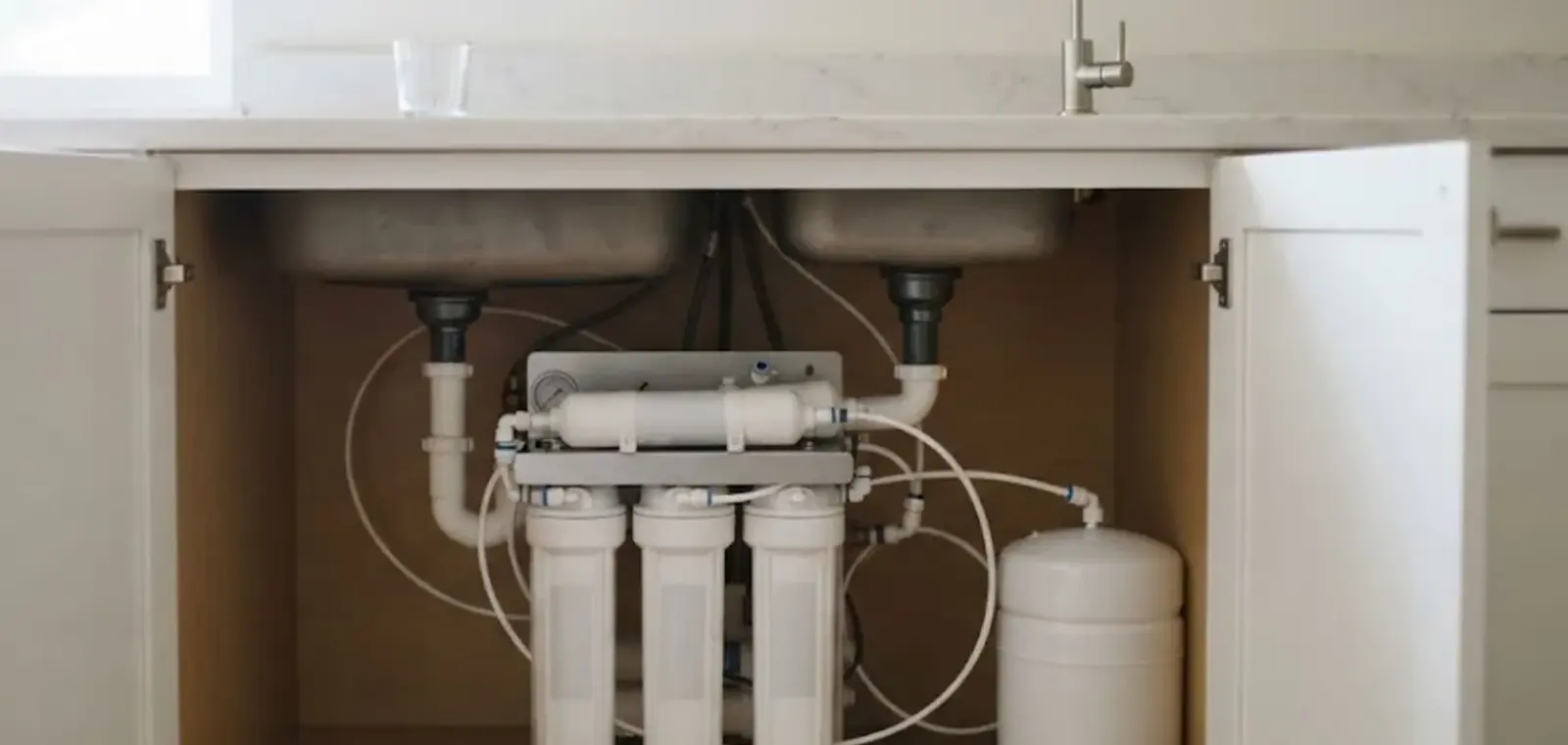
A water filtration system removes something from your water before you use it. What it removes depends on the type. A filter that helps with taste does nothing for scale, and a softener that stops scale does nothing for taste. Choosing well starts with knowing what is actually in your water.
Filtration, softening and purification are different things
| Type | Main job | Does not do |
|---|---|---|
| Sediment filter | Catches sand, rust and particles | Remove dissolved minerals |
| Carbon filter | Improves taste and smell, reduces chlorine | Soften water |
| Water softener | Swaps hardness minerals for sodium or potassium | Improve taste or remove chlorine |
| Reverse osmosis | Removes many dissolved substances at one tap | Treat the whole house |
Whole-house systems treat every tap and appliance. Point-of-use systems treat one tap, usually the kitchen. A common setup is a whole-house sediment filter, a softener where hardness is a problem and a small reverse osmosis unit under the kitchen sink for drinking water.
Start with the utility report
Public water suppliers publish a water quality report each year. It lists what the utility tests for and the results. The report is the cheapest, most reliable place to start, and it says more about your water than any sales pitch. Read it before you buy a system.
A report covers water at the treatment plant and in the distribution system. It does not describe your own pipes. If your house has old lead or galvanized lines, or a private well, a home test is the next step, and a plumber can help.
What a plumber looks at
- Water pressure, since some filters and softeners need a minimum
- The location of the main shutoff and the space for the equipment
- A drain and a power outlet near the system
- The age and material of the existing pipes
A system that is too big for the space or the pressure will not do its job. Installation includes a bypass valve, so water keeps flowing when the cartridge is changed. Skipping it can leave you with no water during a filter change. The water softener page covers the installation side.
Maintenance is part of the cost
Every filter has a cartridge that wears out, and every softener needs salt or potassium. A system that is not maintained can do more harm than none. A clogged sediment filter cuts pressure. A spent carbon filter can pass contaminants it should have caught.
Questions to ask before you buy
- What exactly does this system remove, and what does it not
- How often does the cartridge or media need to change
- What does a year of upkeep involve
- Does the system have a third-party performance listing
- Where does the wastewater go, and is a drain needed
Installation notes that save trouble
Most systems go on the main line near where it enters the house, before the water heater. That protects the heater and every fixture. A point-of-use unit goes under the sink and needs a small faucet at the counter. Leave room to change cartridges without tools or a crawl.
Check the drain requirements. A softener discharges salty backwash and needs an air gap to the drain. A reverse osmosis unit also sends wastewater to the drain. Both need to be done properly, so the drain cannot back up into the equipment. This is one reason a plumber is worth hiring even for a small system.
Reading a product label without being misled
Look for performance claims that name a test standard, not just words such as pure or healthy. A label that lists what the filter reduces, and by how much, is more useful than one that says it cleans water. Check how long the cartridge lasts in gallons or months, and what the replacement costs. A cheap filter with expensive refills is not cheap.
Be careful with claims about health. A filter is a tool for taste, particles or specific substances, and it should not be treated as a medical device. If you have a health concern about your water, talk to your doctor and read the utility report. A plumber can install the equipment, but the choice of what to remove is yours.
A Hilliard note: what Columbus says about the water
Columbus lists Hilliard among the communities it serves with water, and states that it softens water to an average of 120 parts per million, about 7 grains per gallon. That is moderately hard. Hardness is the reason you see white scale on faucets, in kettles and inside water heaters.
Whether a softener is worth it for you is a personal call. Scale shortens the life of a water heater and clogs aerators, and a softener slows both. Taste and chlorine are a different matter, and a carbon filter at the kitchen tap handles those.
Common myths
A single filter does not fix everything. Marketing for a whole-house system often promises more than the equipment can do. A softener does not make water safe to drink, and a drinking water filter does not protect your water heater. Match the tool to the problem.
Taste problems after a plumbing repair are often from air or stirred-up sediment, and they clear in a few days. Persistent taste or color is worth a call. If the water looks brown right after a main break or a meter swap, run the cold tap for a few minutes before assuming the filter has failed.
In Dublin the water comes from the same supplier, and the same report applies. See the Dublin plumber page if you need a visit there.
Where this fits with the rest of your plumbing
Filters and softeners can hide a plumbing problem, such as pipe corrosion, as well as fix one. If your water changes suddenly, do not add a filter before you know why. A plumber can check pipe condition, water pressure and the heater. Basement moisture, which sometimes gets blamed on water systems, is a separate drainage matter covered under basement waterproofing.
Questions we hear from callers
No. A filter removes particles or chemicals. A softener removes the minerals that cause scale.
Columbus describes its water as moderately hard, about 7 grains per gallon on average. A softener is optional and depends on how much scale bothers you.
Columbus publishes a report each year. Read it for the substances tested and the results.
Many systems are a same-day install, if the space, drain and power are ready. The plumber will tell you after seeing the location.