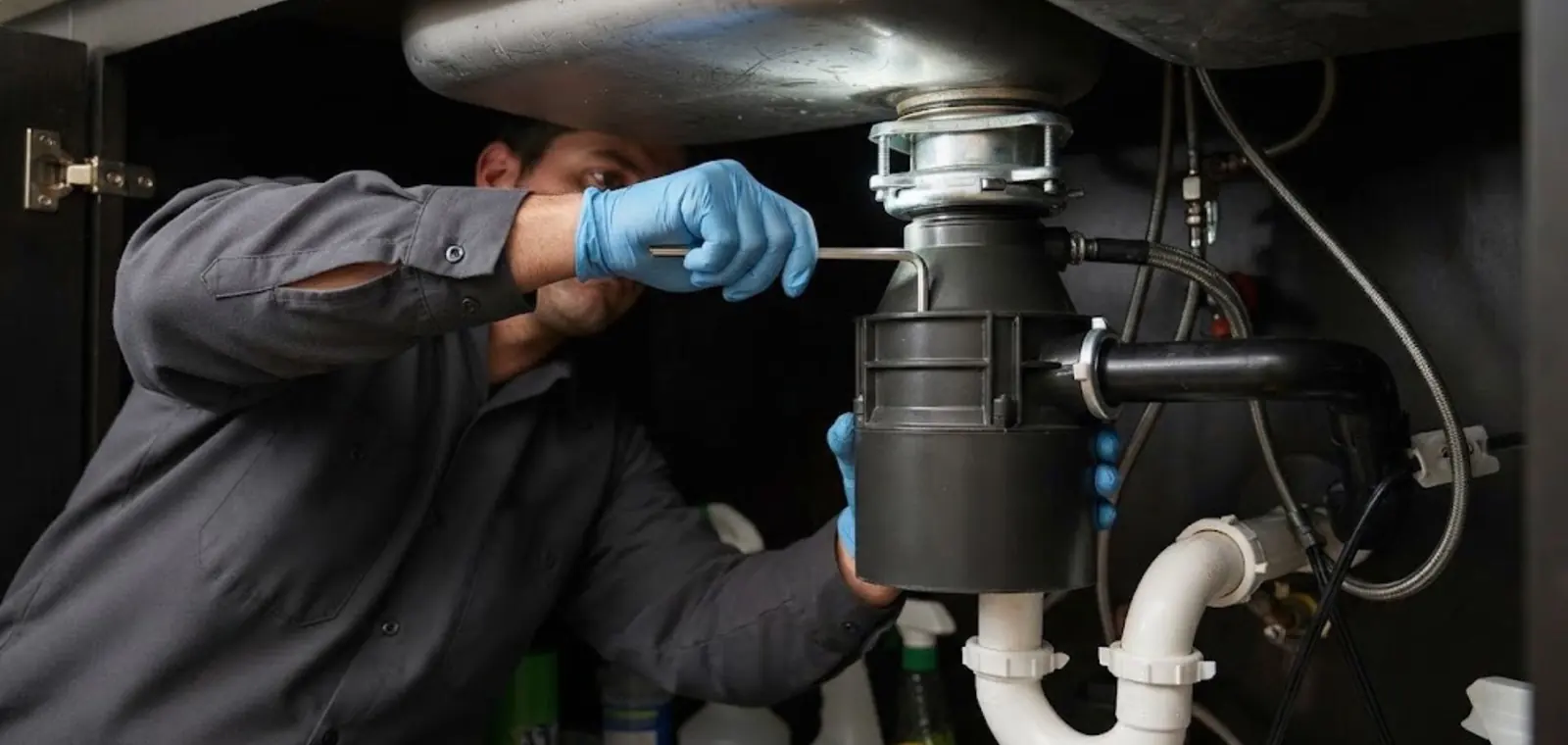
A leaking garbage disposal is an emergency under the sink, because water may be reaching the cabinet floor and anything stored there. Switch the disposal off at the wall switch, close the shutoff valves under the sink and call our 24/7 line. Never put a hand in the grinding chamber, even when the unit is off at the switch. Use tongs or pliers for anything stuck inside.
Humming, jammed or leaking: which one do you have?
The sound the disposal makes tells you what failed. A hum with no spin means the flywheel is jammed. Silence points to a tripped reset button, a dead outlet or a failed motor. A grinding or rattling noise means a foreign object, such as a bottle cap or a piece of silverware. Water under the sink means a seal, a drain connection or the disposal casing has failed.
| Symptom | Likely cause | Typical fix |
|---|---|---|
| Humming, no spin | Jammed flywheel | Free the jam with the hex key, press reset |
| Dead, no hum | Tripped reset, bad switch or motor | Reset, test the outlet, replace if the motor is gone |
| Water under the unit | Failed seal or cracked casing | Replace the seal or the unit |
| Water at the sink flange | Dried-out plumber's putty or mount | Remount the flange with new putty |
| Slow draining sink with the disposal | Clog past the disposal | Clear the line and check the trap |
Repair or replace the unit
A disposal that leaks from the casing cannot be repaired and has to be replaced. A unit that just jammed can often be freed in minutes. If the motor failed and the disposal is more than eight or ten years old, buying a new one costs about the same as a motor repair would, and you get a new warranty.
What goes down a disposal and what does not
- Fine to grind: small food scraps with cold water running
- Avoid: grease, oil and fat that coat the line downstream
- Avoid: coffee grounds in volume, pasta and rice that swell
- Avoid: fibrous foods like celery or corn husks in large amounts
- Never: glass, metal, bones that are large, or any chemical cleaner
A disposal does not cause a slow kitchen drain on its own, but it puts more solid waste into a line that may already be coated with grease. If your kitchen sink backs up even with the disposal clear, see drain cleaning.
Installation and dishwasher connections
When we install a new disposal, we check the sink flange, set the mounting ring, connect the drain and the dishwasher inlet, and test for leaks under pressure and under running water. A common cause of a leak after an owner-install is a loose dishwasher knockout plug or a poorly seated drain gasket, both easy to check.
Electrical safety
A disposal runs on household power, usually on a switched outlet under the sink. If a unit sparks, smells burnt or trips the breaker repeatedly, switch it off at the panel and do not reset it again until it has been inspected.
What drives the price
- Repair versus a new disposal
- The horsepower and model of the replacement
- Whether the sink flange or drain also needs work
- After-hours dispatch for a leak
You get a clear price before work starts. Many Hilliard kitchens have older disposals installed by the previous owner, so we check the wiring and the drain at the same time.
Switch it off and call. The line is answered 24/7.
If the leak seems to come from the faucet or the supply lines, faucet repair covers that. For a wet cabinet that may have a hidden source, read about leak detection.
What to do before the plumber arrives
- Switch the disposal off at the wall switch and the breaker before anything goes near the drain opening
- Never put a hand or a tool into the grinding chamber
- Use the hex key socket under the unit to turn a jammed motor, and only with the power off
- If water is dripping, set a bucket under the leak and keep the cabinet floor dry
Code references for this work
A disposal's power connection follows the National Electrical Code (NEC), and its drain connection follows the International Plumbing Code (IPC) that Ohio's plumbing code is based on.
Questions we hear from callers
Yes. The line is answered 24/7. A leak under the sink is urgent, and we cannot promise a specific arrival time, but we will tell you how to shut off water and power.
Switch it off, then use the hex key slot underneath to turn the flywheel back and forth until it moves freely. Press the red reset and try again. If it still hums, call.
A leak from the casing means the unit has failed internally and needs replacement. A leak from the top flange or side connections can be fixed by resealing.
Many last eight to twelve years. Heavy use, hard water and poor maintenance can shorten that.
Grease no. It coats the line and clogs it later. Coffee grounds in small amounts are fine, but they accumulate in drains, so use them sparingly.
Yes. It needs an electrical outlet under the sink and a drain connection that suits it. We check both on the visit.